
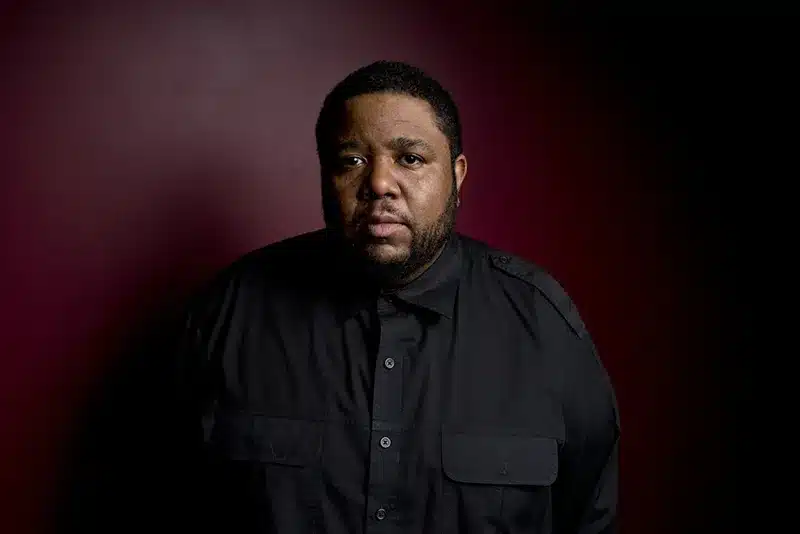

The latest music from drummer and composer Tyshawn Sorey is an extended performance of more than 90 minutes, recorded at the conclusion of a four-night engagement at The Jazz Gallery in New York City. It is a significant reinvention of the Max Roach album Members, Don’t Git Weary from 1968. It is heavy, and it is a blast of imagination and excitement.
The band on Members … Don’t! are a quintet (as on the original), featuring some of the best improvisers in the world: Adam O’Farrill on trumpet, Mark Shim on tenor saxophone, pianist Lex Korten, bassist Tyrone Allen II, and the leader’s drum kit. The singer on the climactic and final “Members, Don’t Git Weary” is the perfect singer for the task in 2026: Fay Victor. The result is an uneasy masterpiece, uneasy by design. Sorey has not merely rearranged songs from the original (composed by pianist Stanley Cowell, saxophonist Gary Bartz, and bassist Jymie Merritt), but he has abstracted them through 21st-century jazz practices.
Roach’s original reflected its times politically—mainly through adapting its title track from the Negro spiritual “Keep Your Lamps Trimmed Burning”—and musically. Roach was participating in the Black liberation politics of the 1960s. He also concocted a set of post-bop jazz with swing but also the soul-infused jazz/funk of “Watermelon Man”, John Coltrane-inspired jazz in triple meter music (Stanley Cowell’s tunes “Abstrusions” and “Effi”, respectively), and a fusiony taste of electric piano from Cowell on “Absolutions”, Merrit’s striving melody that, if you can bear to hear the term, prefigures 1970s “sprititual jazz”.
The new Tyshawn Sorey interpretation does not lean back on those elements of the grooving 1960s vanguard. Clear melodies emerge but only eventually, peeking around corners. Members … Don’t! includes long stretches of freedom and group interaction that jumble and reshuffle compositional form. This music is unsettling. Like today’s politics.
Max Roach was a musical revolutionary and political activist. Along with Charlie Parker and Dizzy Gillespie (and fellow drummers like Kenny Clarke), he reimagined the role of a jazz drummer as the music transitioned from swing to the wilder, more rhythmically daring form called “bebop”. Then, as a great bandleader, he guided jazz into more freedom.
The explicit political lens in his music became plain on 1960’s We Insist! Max Roach’s Freedom Now Suite with his wife, vocalist Abbey Lincoln. The following year, they protested the murder of the new prime minister of Congo, just freed from colonialism, during a meeting of the United Nations Security Council. Eight years later, in the wake of civil rights successes but also the political assassinations of Malcolm X, Martin Luther King, and the Kennedy brothers, he released Members, Don’t Git Weary.
The new recording is, if anything, more revolutionary.
Where Roach started “Abstrusions” with horn hits and soul band drama, a blues theme that sets up a grooving piano solo that fills up the under-four-minute track, Tyshawn Sorey begins his 13-minute version with a ruminative duo between Korten’s swirling piano and O’Farrill’s questioning trumpet. It conforms to no set tempo, much less a soul groove. The conversation is intimate and abstract, rather like a couple discussing complicated feelings without having some kind of “solution”. Sorey’s drums subtly slip into the dialog four minutes in, and Allen doesn’t ground the band with his bass for an additional couple of minutes, leading to a different kind of groove than what Roach gave us. The new version is a garrulous free ramble for O’Farrill and Shim to improvise on. Only in the final minute do they play the harmonized melody.
As is the practice with his current piano trio, Sorey has designed this music so that one song flows directly into the next. “Effi”, the catchiest of the original themes, appears for a split second as “Abstrusions” concludes and then explodes into a high-energy collective improvisation. The melody, transformed through the Sorey kaleidoscope, doesn’t appear until after Korten and O’Farrill take two of the best solos of the album, sparkling things that raise the hairs on the back of your neck. Shim gets in on it all too, and the band brings it to a climax with a sharp, composed lick.
“Absolutions” follows, played as an impressionistic piece that morphs from piano ruminations to a mounting succession of traded horn solos played over the kind of tumbling-free Afro-Cuban groove that Tyshawn Sorey owns. A curious and wonderful section then follows, with O’Farrill using a synth and electronic effects on his trumpet, generating yet another color for this band before the beautiful theme, “Equipoise”, finally emerges. Korten is essential throughout this contemplative, 26-minute performance. His piano plays a repeated figure that channels both McCoy Tyner from the 1960s and the jazz groove pianists of the 2000s (Robert Glasper, Aaron Parks), working in sympathy with Sorey’s time to make the music gush forward with a gentle kind of modern swing.
“Libra” by Gary Bartz is a jaunty tune that sets up the set’s climax. In the Max Roach recording, his “Member Don’t Git Weary” appeared between “Equipoise” and “Absolutions” on side two, but Sorey uses it as his emotional climax. The vocalist is the marvelous Fay Victor, an ideal choice. Victor, whose Life Is Funny That Way from 2024 (with her band Herbie Nichols SUNG) was one of the best jazz vocal recordings of the century so far, combines ideal “jazz singing” chops with two other elements: a vocal connection to soul and blues singing and an ease and confidence working as a free vocal improviser.
Victor nails the heart of the song, but she then enters a wild collective improvisation with the whole band. She is neither the “center” of it (as singers so often need to be) nor lost in an exchange with a group of virtuosic players. Rather, what emerges is the metaphoric and musical high point of Sorey’s Members … Don’t! The lyrics of the old spiritual advise: “Members don’t get weary, members don’t get weary, for the work’s mos’ done. Keep your lamp trimmed and burnin’, for the work’s mos’ done. I’m goin’ down to the river Jordan, when my work is done.”
As the musicians slide into ecstatic, rising improvisatory conversation, it is clear that they are demonstrating the commitment and sustained energy—creative and personal—that is necessary to sustaining any fight for freedom. Some listeners, I know, will find the center of this track to be somewhat atonal or harsh, but I strongly suggest you let it flow over you and take you on its journey. The performance ends in maybe five full minutes of musical joy and celebration, a catharsis that brings Victor to sing, “I’m gonna march with the tallest angel, when my work is done.”
It is a promise and maybe a prediction, the idea that conviction and community—all these voices, musical and communal—are the way that we can get to the other side of hard things. Tyshawn Sorey has created one of the best albums of the year, surely.