
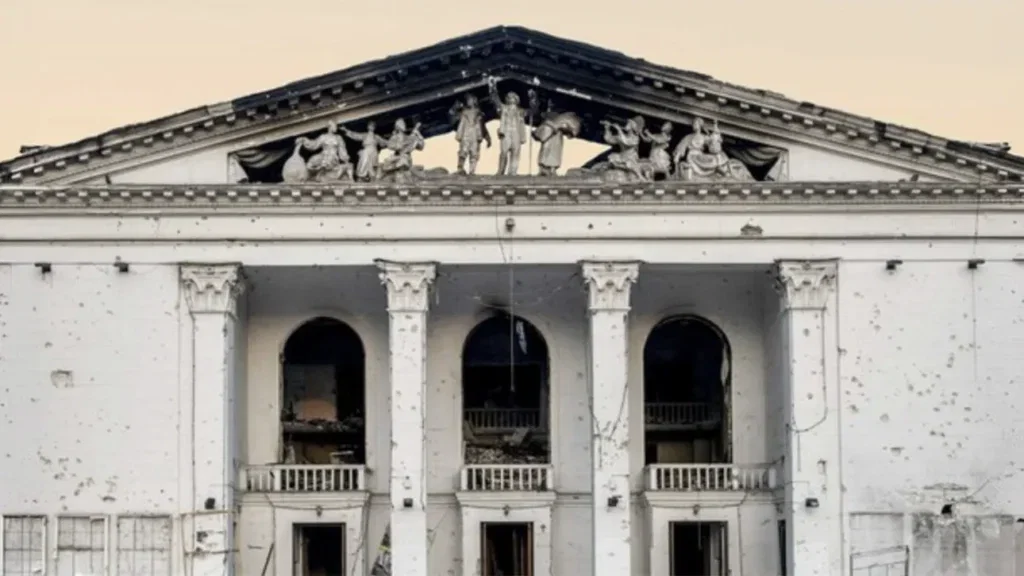
Scrawled on the plaza stone, in both the front and back of the ornate Corinthian portico of Mariupol’s Drama Theatre, the word “дети” — “children” in Russian — was unmistakable. Days later, only one was still legible under the rubble where the building once stood. The theater, a cultural cornerstone for more than six decades, was destroyed in a March 16, 2022, bombing while sheltering hundreds of people.
The Cyrillic word was brushed on by employees who, when the Russia-Ukraine war broke out, were yanked from their peacetime dramaturgy and thrown into unscripted purgatory. In their city, 35 miles from the border, the theatre workers suddenly found themselves sheltering hundreds of Ukrainian refugees. James Verini’s The Theater: Courage and Survival in the Defining Atrocity of the Ukrainian War offers one of the most detailed accounts yet of the theater’s peripeteia from house of entertainment to house of survival—then to pulverized limestone.
The strike on the theater is widely considered to be the deadliest attack of the war to date. Even setting aside the staggering, if still unverified, death toll, Verini makes the case that the strike remains perhaps the most prescient for revealing the conflict’s “innermost animus”. It wasn’t just an anachronistic attack; it cemented a campaign of cultural erasure.
There are very few accounts of this moment despite the fact that it came to define the conflict. There are no public photos of the theater bombing. Most survivors deleted any footage they had on their phones before crossing Russian checkpoints, fearing they wouldn’t be allowed out. Verini reconstructs several survivors’ intersecting stories in vignettes.
While they all suffered different fates, they each describe similar experiences: hearing disjointed screams alongside the calm silence of grief, seeing blood-streaked limbs caked in white dust sticking out under the detritus, attached to both the dead and the living. “That day,” a survivor told Verini, “we realized the Russians had come to kill us.”
His narrative features a cast of remarkably strong supporting characters to the protagonist, which is not any one person, but Ukraine as an identity itself: a playwright, a lighting director, and a handful of actors who, three weeks prior to the attack, when the war was breaking out, had acquiesced to turn the revered theater into a safehouse for as many as 1,500 refugees. They were professional storytellers, not humanitarians, or as Verini put it, “they knew how to mount Molière, not a shelter,” but the conditions required them to step up, they told him, for the highest-stakes improvisation challenge of their lives, with one critical distinction: they could never come offstage.
So backstage halls became open-air dormitories, dressing rooms were made into clinics, and the prop storeroom a scullery. By some miracle and the grit of the theater’s volunteers, residents’ wounds were treated, their families fed, and their lives, just barely, held together.
Its operations were rife with challenges, amid freezing air, overcrowded rooms, and a bevy of personal dynamics as agony set in that no help was on the way. In one moment that both perfectly highlights the theater’s chaos and the “cost-effective mordant Ukrainian wit”, Verini noticed sojourned among survivors, one resident described the theater’s living conditions with a dry, “There were no conditions.”
Beyond the perseverance of the theater people, Verini’s reporting is marked by the distinct theme that this war is not only territorial but also cultural. This community, seeking refuge in what was a community gathering place well before the war, is a microcosm of a battle that had taken root across Ukraine long before the war began.
The name “Ukraine” comes from the Slavic word for “borderland”, Verini points out. Nowhere in Ukraine has it felt so cogent as in the Donbas region, where Mariupol lies. As an area that has faced Russian incursion in its not-so-distant past, most Ukrainians were raised on Russian culture. Some believed it was superior, and that Moscow should govern them again; others believed Ukrainian culture was best and didn’t buy into Kremlin propaganda.
These factions cohabitated, though not without friction. As Verini argues, the war in Donbas “was an invasion, yes, but also a species of civil war, which is why it never ended.” It left a bifurcation between Ukrainian society—the separatysty, their epithet for Russian sympathizers, and the Ukrainian loyalists—that was then forced to converge in the confines of the theater. No matter which country had more refined plays in one’s mind, in a time of war, the basement of this Ukrainian one would have to do.
For the Mariupoltsi in the theater, as is true across Ukraine, keeping their identity alive was an undercurrent of their own survival. For the country’s youth, teenage rebellion was cultural, with teens renouncing Russian entertainment in favor of Ukrainian and Western alternatives. For the adults who were fed Kremlin media growing up, the tenor of rebuke against the Russophiles was not so different. The theater-dwellers sang Ukrainian and Western songs to drown out the Russian bombardments nearby, in defiance of the invasion, until the piercing racket of the fusillade relented.
This is the existential fight at the heart of this war. A battle between Russia and Ukraine over the right to culture, people, and society. When the theater was decimated, so, too, was any Russophilic delusion that the Kremlin was aiming to shield the civilians from the violence and bring them into a life of Russian splendor. For Russia to win, they realized, any semblance of Ukraine was intended to go up in ashes.
Russia denies involvement in the theater strike, maintaining that it was Ukrainian subterfuge that caused the theater to collapse—a claim that strains against the survivor testimony of The Theater. Since the war’s outbreak, the United Nations has documented at least 526 Ukrainian cultural sites that have been damaged, including churches, museums, and libraries, among others. Many notable cultural figures have been killed.
Meanwhile, a few months ago, the theater reopened under Russian occupation. Its inaugural performance in December 2025 was a Soviet-era fairytale. It was not an innocuous choice, but a symbolic one: an attempt to overwrite one of the war’s most documented atrocities with a narrative of control. The use of a literal work of fantasy to do so is painfully ironic.
Mariupol and its neighbors have cycled from rubles to rubble and, now, back to rubles again. Still, rebuilding, as history makes clear, is not a neutral act. If, as Verini’s sources question, Vladimir Putin claims Russians and Ukrainians are one people, why tear the borderland down only to rebuild it again?
The word “дети” has been erased from the plaza of Mariupol’s Drama Theatre, but the story it marked endures in its survivors, resisting any attempt to bury it beneath a new façade.