
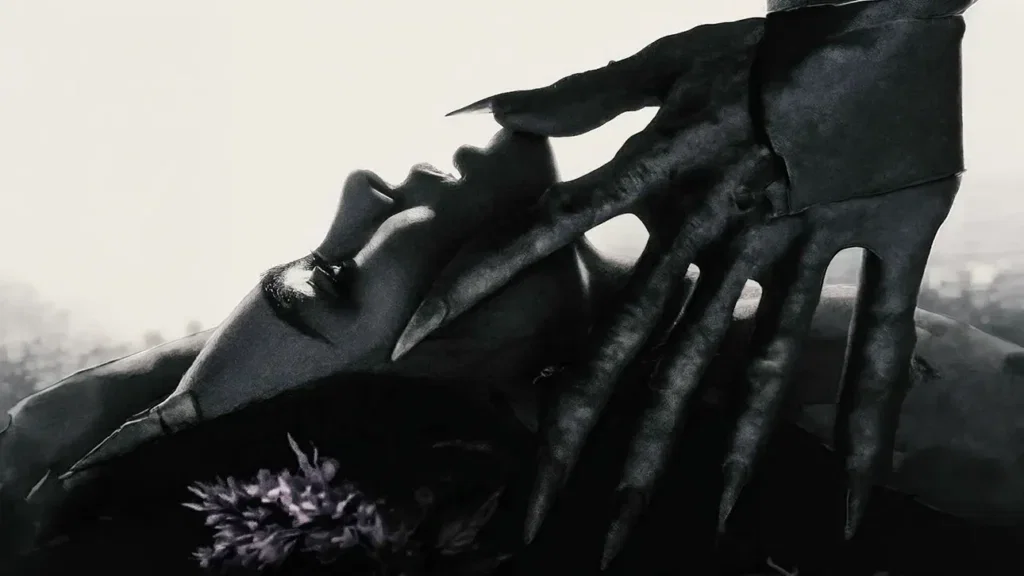
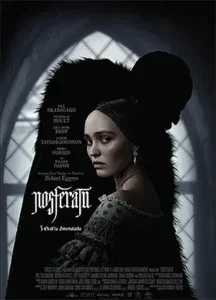
Across two centuries of literature and film, the vampire has proven less a monster we flee than one we cannot resist. Unlike most monsters, the vampire in its many forms, not least the Romanian Nosferatu, evinces a capacity to attract us, to draw us in. Surveying the history of the vampire is all the evidence we need to prove we are under its hypnotic spell.
Seasons of the vampire come and go, but the vampire has endured, changed, and adapted. It is, paradoxically, both a repulsive Other and an attractive lover. It has evolved from a symbol of feudalistic decay and aristocratic predation into multifaceted metaphors for a variety of cultural anxieties about socioeconomic class, the irrationality of sexual desire, the cruel inhumanity of corporate power, and more.
From the earliest literary vampire, Lord Ruthven in John William Polidori’s The Vampyre (1819), to the grotesque Count Orlok in F.W. Murnau’s Nosferatu (1922), this blood-drinking, animated corpse has been fecund soil for artists and storytellers to sow story seeds. Despite its thematic shape-shifting in meaning, however, an enduring kernel remains: the vampire provokes fear even as it draws us into its embrace.
Robert Eggers’ Nosferatu (2024) revisits this archetype by returning to the vampire’s roots in alien, occult monstrosity, challenging more recent romanticized portrayals that have dominated popular culture over the last few decades. Here, we explore the literary and cinematic evolution of the vampire, examining how these representations reflect historical tensions, societal fears, and shifting attitudes toward gender, power, and desire. To what extent are we all Nosferatu‘s Ellen, arms open, continuously dream-calling for our vampire lord to embrace us?
The Ecstasy of Consumer Submission
The Feudal Literary Vampire
The first literary vampire, as distinct from the far older folklore revenant, is arguably Lord Ruthven, created by John Polidori, Lord Byron’s personal physician. A tragic figure, Polidori died by suicide; some speculate as a result of mental health struggles intertwined with the pressures of his association with Byron and his closeted homosexuality.
The Vampyre (1819), often read as a literary lampoon of his infamous patient, is notable for rendering a vampire who passes as an aristocrat and preys upon innocent (virginal) women. In large part due to Polidori’s Ruthven, this predatory focus on women became a defining characteristic of the literary vampire in the English tradition. Yet the pattern is more erotic than simply misogynistic.
The vampire’s attack – an intimate exchange of fluids, a penetration that alters status, and the lingering threat of contagion – operates through sexual metaphor so explicit that it tends to reproduce prevailing heterosexual norms even as it disturbs them. Thus, whether the vampire is male or female – Sheridan Le Fanu’s Carmilla (1872) famously offers a female vampire whose desire for women unsettles Victorian proprieties – the act of vampiric predation functions within a charged framework of sexual taboo.
Even in Bram Stoker’s Dracula (1897), where the Brides eagerly threaten Jonathan Harker, the charge derives from a reversal of expected sexual roles. Women frequently appear as victims to be consumed when they are not themselves vampires, but what is being staged is less a simple gender hierarchy than an anxious dramatization of erotic transgression.
Another aspect of these earliest literary vampires is their class and cultural coding. Lord Ruthven, Carmilla, and later Dracula are aristocratic figures, embodiments of an “old world” feudal sensibility that lingers parasitically within the modern age. They do not merely possess supernatural strength; they inherit dynastic authority.
In this sense, they can be read as the feudal past preying upon the democratic present. Spectators to the modern world of egalitarian aspiration, they stand above us not only because of their immortality but because of their inherited status. This dynamic is crystallized in Robert Eggers’ Nosferatu, when the monster corrects Thomas, the middle-class real estate clerk, and insists he be addressed as “my lord”, not “sir”. The demand is not pedantic; it is ontological. The vampire reasserts hierarchy.
This temporal and class antagonism becomes even clearer in Bram Stoker’s Dracula, where the Count’s medieval Transylvania is set against modern London, a city defined by its technologies: typewriters, telegrams, railways, phonographs. The novel stages a collision between decaying feudal rigidity and a burgeoning world of relative social and gender mobility.
Yet Dracula does not simply haunt this new order; he infiltrates it. He purchases property, navigates legal contracts, and studies timetables. He is at once an archaic lord and a proto-capitalist operator. His predation extends beyond the familiar trope of the aristocrat consuming the young woman; Jonathan Harker, like Mina, becomes prey, and the Brides’ sexual menace reverses conventional hierarchies. Through hypnotic domination – Renfield reduced to a groveling thrall – the vampire demonstrates that hierarchy is not abolished by modernity but merely displaced.
What renders this especially disturbing within ostensibly democratic cultures is not only the vampire’s violence but his restoration of rank. He transforms free subjects into property, citizens into chattel, rational agents into enthralled bodies. In his presence, equality collapses. The vampire’s bite is thus more than erotic or mortal: it is feudal. He reminds the modern West that beneath its rhetoric of autonomy lies a perennial anxiety: that we may still be owned, commanded, and consumed by powers that claim a higher order of being.
Gothic Villains as Proto-Vampires
Interestingly, this figure of the predatory aristocrat who threatens us with thralldom was prefigured in earlier Gothic novels. In Horace Walpole’s The Castle of Otranto (1764), often regarded as the first Gothic novel, Prince Manfred, the tyrannical lord of the castle, preys upon young women, particularly his would-be daughter-in-law, Isabella, his deceased son’s fiancée. Manfred’s obsessive desire to marry Isabella after his son’s death reveals his exploitative, predatory disposition and exemplifies how Gothic passion, drawing on Romanticism and German Sturm und Drang, is frequently marked by the violation of taboo; here, the incest taboo.
The audacious and relentless Manfred establishes the archetype of the Gothic aristocrat who wields power over women and seeks to consume and control them. This figure evolves into the literary vampire. In many respects, the vampire continues and amplifies the Gothic tradition, representing not only personal predation but the broader societal tension between the ancient world and modernity; the arbitrary (and legally sanctioned) privilege of aristocracy to dispose of ordinary members of society as they will.
The Gothic tradition abounds with predatory aristocratic men who consume women, both figuratively and literally. Following Walpole, one of the most infamous Gothic villains is Lord Montoni in Ann Radcliffe’s The Mysteries of Udolpho (1794). Though Montoni does not sexually prey upon Emily St. Aubert, he relentlessly pursues her wealth and inheritance, demanding compliance under threat of violence and death.
As an Italian nobleman with a bloody military past, Montoni embodies decayed nobility desperate to reclaim waning power through coercion and brute force. The sexual undertones of his domination remain restrained but foreshadow the more explicit eroticized violence that erupts in later Gothic works, most notoriously Matthew Gregory Lewis’s The Monk (1796). In Lewis’s novel, what Walpole and Radcliffe imply becomes horrifyingly overt.
Brother Ambrosio, the titular monk, is consumed by lust for a young woman who is eventually revealed to be his long-lost sister. His descent into carnality leads him to imprison, rape, and ultimately murder both his sister and mother after entering into a pact with the devil. The Monk lays bare the corruption lurking beneath medieval religiosity and exposes the violence concealed within feudal hierarchies.
Yet there is a crucial distinction between these Gothic villains and the vampire who succeeds them. Manfred, Montoni, and Ambrosio are indigenous tyrants. They are inseparable from their castles, monasteries, and ancestral estates; their authority seems to emanate from the land itself, as though despotism were sedimentary. They are rooted figures; extensions of the feudal soil they inhabit.
The vampire, however, complicates this inheritance. Though aristocratic and feudal in temperament, he is persistently marked as foreign. Dracula must transport the soil of Transylvania in coffins; his vitality depends upon imported earth. He is ancient yet invasive, rooted yet uprooted.
This doubleness generates much of the vampire’s symbolic power. On the one hand, he extends the Gothic archetype of the predatory aristocrat who embodies the oppressive past. On the other hand, he appears as an alien contagion, a foreign agent who threatens the modern nation-state from without. If the Gothic villain represents tyranny grown from within the land, the vampire often represents tyranny that crosses borders.
In Stoker’s Dracula, this tension becomes especially pronounced. The Count is both relic and invader: a feudal lord emerging from medieval Transylvania into technologically modern London. He purchases property, navigates legal contracts, and exploits railways and shipping routes even as he carries with him the soil of his homeland. He is simultaneously archaic and eerily modern; an aristocrat who moves through global networks. Thus, the vampire becomes liminal: at home nowhere except in his native earth, yet capable of infiltrating and contaminating the urban bloodstream of modernity.
This generative tension between indigenous rootedness and foreign contagion allows the vampire to mediate evolving cultural anxieties. He is the feudal past made ambulatory, hierarchy unmoored from place. In democratic, ostensibly egalitarian societies, this is particularly disturbing. The vampire restores rank. He transforms free subjects into property, rational agents into thralls, citizens into chattel. Whether emerging from ancestral castles or arriving as invasive disease, he collapses the modern fiction of equality. In his presence, autonomy falters; hierarchy reasserts itself; and the old world, whether buried in the soil or imported in a coffin, rises again to claim dominion.
These Gothic villains – associated with decaying aristocratic feudalism, ravenously predatory (often sexually), undeterred by taboo – form the foundation of the later literary and cinematic vampire. They reflect a tension between the Anglophone Protestant paranoid vision of the Catholic medieval world and the emerging sensibilities of the modern middle class.
Although the tradition of the predatory aristocrat resurfaces with vampires like Lord Ruthven and Dracula, who continue to exploit the Gothic imagery of old-world decay, it is important to recall that the vampire is not merely a depraved aristocrat but a supernatural monster originating from Eastern European folklore, and so allows writers new thematic material to work with.
For example, where the earlier Gothic novels use such Gothic villain figures to critique feudal power or institutionalized religious hypocrisy, the vampire, a blood-sucking monster cursed with unlife, a figure associated with Eastern European folklore, expands the theme to include anxieties about modernity, gender roles, sexuality, contagion, homophilia, science vs. occultism, consumption practices, and more. In this way, the vampire is emphatically not merely a villain but a monster: non-human, alien, Other, a symbol of shifting and accelerating cultural fears, fears that swell and break the dams of the symbolic framework of a depraved aristocrat.
The Cinematic Racialized Vampire

F.W. Murnau’s Nosferatu (1922), an unauthorized film adaptation of Bram Stoker’s Dracula, alters key elements of its Gothic source material as well as earlier Anglophone literary representations of the vampire. One significant and troubling aspect of the film is its incorporation of anti-Semitic visual tropes into the portrayal of Count Orlok (Max Schreck).
Created during a period of intensifying anti-Semitism in Germany, the film resonates uneasily with the long European tradition of blood libel, which falsely accused Jewish communities of preying upon Christian populations. Orlok’s physical appearance – his hooked nose, hunched posture, elongated fingers, and rat-like features – echoes caricatured stereotypes pervasive in early 20th-century Europe. In Nosferatu, the vampire becomes more than a supernatural remnant of feudal tyranny; Orlok represents an alien, foreign, and invasive force threatening a wholesome Christian body politic.
This interpretation reflects anxieties in Weimar Germany, particularly tensions surrounding urbanization, shifting economic power, and the negative perception of wealth increasingly derived from non-land-based professions, e.g., law, banking, intellectual labor, and entertainment, rather than agrarian property and hereditary estates. The film’s imagery of plague, infestation, and vermin reinforces this association.
Orlok’s journey from his mysterious homeland into a German town mirrors fears of immigration and cultural encroachment, transforming the vampire into a figure of epidemiological and racialized threat. Unlike Stoker’s novel, which juxtaposes aristocratic antiquity against London modernity, Murnau’s Nosferatu strips away much of Dracula’s refinement. Orlok is not a charismatic nobleman but a grotesque and animalistic predator. His menace is not seductive infiltration but visible contamination. He does not blend; he infects.
In this sense, Murnau intensifies the vampire’s foreignness by abandoning aristocratic elegance in favor of exaggerated otherness. Orlok is framed less as a decadent lord and more as a spiritual contagion capable of warping both body and space.
A useful counterpoint emerges in the American reconfiguration of the vampire nearly a decade later in
Tod Browning and Karl Freund’s Dracula (1931), starring Bela Lugosi. Lugosi restores the aristocratic suavity largely absent from Orlok. Cloaked in evening wear, his hair slicked and posture erect, he reclaims the vampire’s dynastic poise and cultivated restraint.
Yet alienness is not erased here; it is aestheticized. Lugosi’s thick Hungarian accent marks him unmistakably foreign, even as his bearing signals Old World nobility. His performance oscillates between urbane politeness and predatory stillness; the strained smile, the sudden feral intensity in his gaze, the deliberate, almost hypnotic cadence of speech. Where Orlok’s otherness is grotesquely externalized, Lugosi’s Dracula embodies a subtler dissonance: he passes socially, but never fully belongs.
The contrast clarifies two cinematic pathways for negotiating the vampire’s foreignness. In Murnau’s film, otherness is made monstrous and physiognomic, collapsing aristocratic privilege into racialized caricature. In Browning and Freund’s version, otherness is sublimated into performance: accent, gesture, and erotic magnetism. This allows the vampire to retain aristocratic glamour while remaining culturally estranged.
If Orlok incarnates xenophobic fear of invasive contagion, Lugosi’s Dracula channels anxieties about the seductive foreigner who infiltrates bourgeois society from within. Taken together, these films demonstrate how the cinematic vampire navigates the tension between feudal hierarchy and alien invasion in divergent ways. Whether rendered as grotesque plague-bearer or hypnotic aristocrat, the vampire continues to embody anxieties about sovereignty, contamination, and social displacement. Nosferatu thus stands not only as a Gothic horror film but also as a troubling reflection of its era’s prejudices, while Lugosi’s performance reveals how easily foreignness can be transmuted into allure, without ever fully shedding its menace.
Nosferatu‘s Critique of the Commodification of Monstrosity
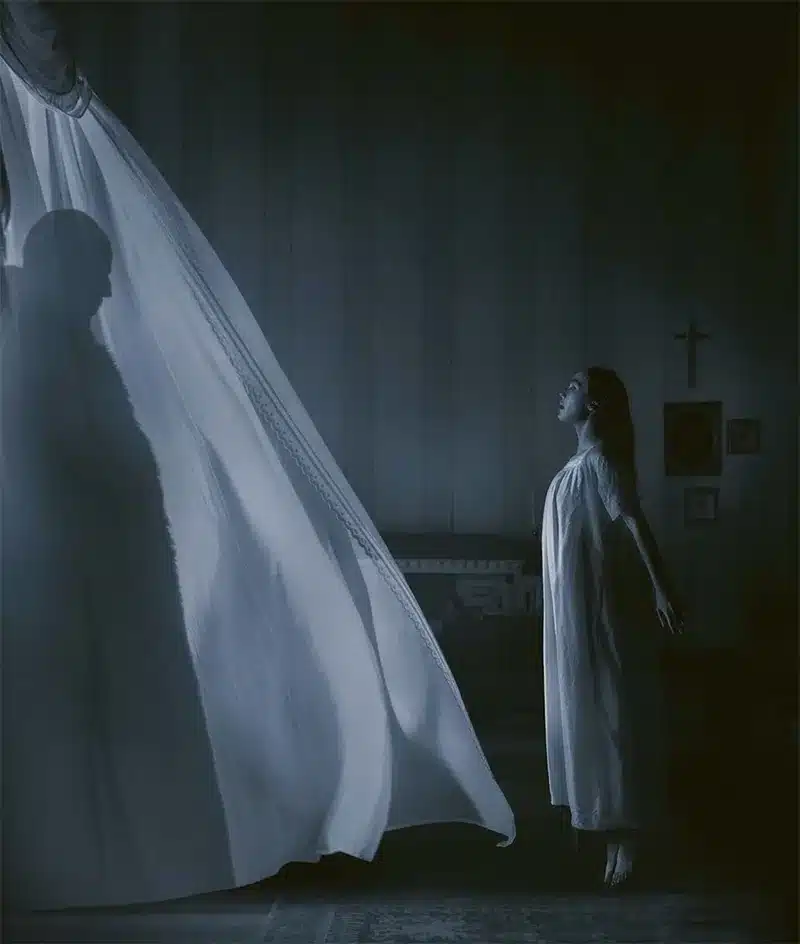
Robert Eggers’ Nosferatu draws deliberately from the long cinematic genealogy of the vampire, most directly from F.W. Murnau’s Nosferatu, yet it does so within a cultural landscape saturated by the romanticized vampire. From Browning and Freund’s Dracula (1931) through Joel Schumacher’s The Lost Boys (1987), Interview with the Vampire (1994), and the Twilight cycle (2008–2012), the vampire has frequently been reimagined as alluring, charismatic, and even aspirational.
These films retain traces of monstrosity, yet increasingly blur the boundary between predator and celebrity, curse and lifestyle. The vampire becomes a tragic antihero, an erotic icon, a commodified outsider. Dangerous, but desirable.
Eggers consciously resists this trajectory. Drawing less from Lugosi’s aristocratic suavity than from Murnau’s grotesque physiognomy, he reasserts the vampire as corpse rather than idol. His Orlok (played by Bill Skarsgård) is not a darkly glamorous immortal but a decaying relic; cadaverous, shadow-wreathed, and steeped in rot. Pestilence accompanies his presence; social order destabilizes in his wake. If late 20th- and early 21st-century cinema domesticated the vampire into consumable melancholy, Eggers seeks to restore its inhumanity and metaphysical dread.
This restoration is not merely aesthetic. Eggers reactivates the vampire’s earlier symbolic functions: feudal domination, invasive contagion, and the collapse of democratic subjecthood. His Orlok does not shimmer; he commands. The insistence on hierarchy – echoing the Gothic tyrants and the feudal dynamic embodied in the demand to be addressed as “my lord” – returns stripped of romantic camouflage.
In this rendering, vampiric seduction no longer gestures toward aspirational transcendence but toward degradation. To desire the vampire is to submit to one’s own abasement. Yet the erotic charge that has long animated the myth is not eliminated. Rather, it is rendered necrotic.
Nosferatu’s most disturbing images, particularly Ellen’s (Lily-Rose Depp) embrace of the corpse-like Orlok, refuse any clean separation between allure and revulsion. Desire persists, but it is inseparable from decay. The fundamental dialectic identified earlier – fear entwined with attraction – is intensified rather than resolved. The viewer is compelled to confront the unsettling fact that the vampire’s magnetism has always been entangled with death and domination.
Eggers thus participates in a parallel monstrous lineage within vampire cinema, alongside works such as David Slade’s 30 Days of Night (2007) and Tomas Alfredson’s Let the Right One In (2008), that periodically interrupts cycles of romanticization. What distinguishes his intervention, however, is its timeliness.
In an era in which the vampire has become a marketable brand and lifestyle aesthetic, Nosferatu implicitly critiques the commodification of monstrosity itself. The figure once feared has been rendered consumable; Eggers reverses the transaction. His vampire consumes rather than invites consumption. By returning to rot, plague, and feudal dread, Eggers rebalances the myth without severing its erotic undertow.
The vampire once again stands above humanity, not as a tragic idol or misunderstood outsider, but as a sovereign predator. In doing so, the film harmonizes with the Gothic and Murnauvian traditions while speaking pointedly to contemporary anxieties about spectacle, hierarchy, and the uneasy pleasure taken in monsters who promise both transcendence and annihilation.
Eggers’ Nosferatu revisits and complicates the sexual dynamics of vampiric predation by departing from one of the genre’s most consistent features: coercion. In the dominant tradition, most clearly in Stoker and in the Lugosi and later adaptations, Dracula is effectively depicted as a rapist. He takes by force of will or force of arms. His victims are immobilized, hypnotized, overpowered. The bite is not negotiated; it is imposed. The vampire’s sexuality in these works is inseparable from domination, violation, and the collapse of bodily autonomy. The swooning victim, neck exposed, is not choosing but succumbing.
Eggers alters this structure. Orlok does not merely seize Ellen; he demands her consent. The narrative hinges on her explicit willingness to offer herself to him. From one perspective, this shift appears to register contemporary cultural preoccupations with agency and affirmative consent. Ellen’s decision becomes the mechanism through which Orlok is ultimately destroyed, converting what appears to be sexual submission into a paradoxical form of power. Her choice structures the film’s resolution.
Yet the transformation is not simply progressive. Consent in Eggers’ film operates within an already established asymmetrical hierarchy. Orlok remains a sovereign predator; Ellen’s agency exists within the gravitational field of his domination. The language of choice does not erase the vampire’s verticality but reframes it. The woman’s consent becomes entangled with her willingness to submit to a monstrous, male-coded force that promises annihilation as much as ecstasy.
In this way, Eggers interrogates the fraught terrain between coercion and desire. This interrogation becomes especially pointed in the intimate scene between Ellen and her husband, Thomas (Nicholas Hoult). Framed with unsettling intensity, Ellen’s posture and gaze evoke both erotic hunger and humiliation. After accusing Thomas of inadequacy in comparison to Orlok’s overwhelming force, she incites a brutal, spontaneous sexual encounter.
The scene resists easy moral categorization. Unlike Orlok’s ritualized and contract-bound claim – legalistic, ceremonial, explicitly articulated – this encounter is impulsive, non-discursive, and violent in its urgency. If Orlok’s predation is framed as formally consensual, Thomas’s lovemaking is charged with aggression and wounded pride. Nosferatu destabilizes any simplistic alignment between consent and ethical clarity.
The contrast exposes a deeper ambiguity. Traditional vampire narratives encode vampirism as rape; Eggers retains that history but overlays it with the language of choice, creating a disturbing paradox. Is consent meaningful under conditions of metaphysical domination? Does articulated agreement neutralize the asymmetry of power? Conversely, do spontaneity and passion, often culturally coded as “authentic”, risk veering toward coercion when stripped of verbal negotiation?
Rather than resolving these tensions, Eggers heightens them. His film situates desire at the intersection of hierarchy, agency, and annihilation. In doing so, it harmonizes with the broader trajectory traced earlier: the vampire remains a figure of vertical power, reducing humans to vessels. What changes is the mechanism of submission. Where Dracula conquers through hypnotic force, Orlok compels through the seduction of consent. The underlying structure of domination persists.
The difference lies in how modern sensibilities require that domination be refracted through the rhetoric of choice. Eggers’ Nosferatu thus stages not the eradication of vampiric rape but its mutation. The vampire no longer simply takes; he secures agreement. Yet the hierarchy remains intact, and the cost of that agreement is death. The film’s unsettling power derives from this unresolved tension between autonomy and enthrallment, passion and coercion, consent and doom.
We Embrace Our Monstrosity
Robert Eggers’ Nosferatu returns the vampire to its grotesque and alien origins: a corpse animated by hunger, kin to rats, plague, and maggoty rot. In doing so, the film decisively rejects the modern tendency to romanticize vampirism as tragic glamour or aspirational immortality. Eggers restores dread. Yet, his most provocative contribution lies not merely in resurrecting the monstrous vampire but in questioning why we, the audience, are so eager to see it rise again.
This brings a self-reflexive dimension to the horror. While the vampire acts as an invasive predator on screen, the film suggests it is also a commodity we repeatedly exhume. Released on Christmas Day, Nosferatu knowingly participates in the very cycle it scrutinizes: the ritual resurrection of familiar intellectual property. In this light, the vampire shifts from a symbol of feudal domination to a metaphor for our appetite for repetition. We do not seek novelty; we seek recurrence, returning to the coffin to lift the lid again and again.
The film’s sexual politics reinforce this diagnosis. By reframing predation through the language of consent, Eggers stages a modernized form of enthrallment. Domination persists, but it now passes through contractual agreement, articulated choice, bureaucratic ritual; the signed document, the spoken vow. The vampire no longer simply conquers; he secures compliance. This mutation parallels contemporary structures of power in which subjection is refracted through procedure, administration, and algorithmic sorting. We choose the systems that bind us. We sign the contracts. We subscribe. We pledge.
Thus, Nosferatu becomes less a nostalgic homage than a meditation on the psychosocial condition the vampire has always dramatized: the ambivalent desire to relinquish our very freedom. The figure that once symbolized aristocratic tyranny now mirrors decadent late-capitalist enthrallment. The ecstasy of submission – to the vampire, to the corporation, to the franchise reboot, to the Kickstarter campaign – offers relief from the heavy burden of autonomy. Art demands risk, novelty, and the exercise of will; commodity promises repetition, predictability, dopaminergic immediacy. Eggers’ vampire myth clarifies that we often prefer the latter.
Eggers’ Nosferatu, therefore, harmonizes with the vampire’s deeper symbolic history even as it confronts its contemporary mutation. The monster stands above us not only as a feudal lord or foreign invader but as a reflection of our own appetites, a lord we invite in to ravage us. We consume the vampire, yet in doing so, we reveal our willingness to be consumed by spectacle, repetition, and the comforts of ideological consensus and political homogeneity.
We have become Ellen, paralyzed at the window, having replaced the vital act of creation with the cold act of purchase. Our arms are wide open, waiting for the product, the content, the commodity to consume us.