

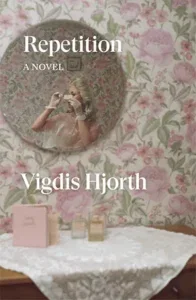
Vigdis Hjorth’s translated novels are a universe unto themselves. They present a networked constellation of recurring themes, archetypes, and interpersonal dynamics that are swapped, slightly inverted, and subtly recontextualized in service to a central character’s moral transformation. The consistency of Hjorth’s authorial voice holds everything together, putting each work in conversation with one another and creating a sense of uniformity across her broader oeuvre.
She often writes from the perspective of a middle-aged woman with an artistic practice, who is unable or unwilling to conform to the values and expectations of middle-class bourgeois life, leading to conflicts at work, at home, and in romantic relationships. Despite the significant overlap in style, tone, and content, each work remains distinct, much as a memory is recast as it is continually recollected over time – the broad outlines stay the same, but the finer details and emotional resonances remain in flux.
Hjorth’s latest translation, Repetition, bears the same title as an 1843 novel by Søren Kierkegaard, the same novel from which she cribbed the title for Long Live the Post Horn! (2012). If there’s any novel Repetition appears to be directly in conversation with, it is 2016’s Will and Testament – a pitch dark, sometimes absurdist depiction of a narrator, Bergljot, confronting her family with allegations of intrafamilial child sexual abuse, precipitated by an inheritance dispute. Bergljot’s stake in two cabins in Hvaler goes unrecognized by her family, much like the trauma she inherited from her father’s abuse, which took place from age five to seven.
Repetition reads as if from the same narrator as Will and Testament, but this narrator is unnamed and depicts a different point in the life cycle of this, or perhaps another very similar, estranged family. Everything rises to the level of similarity, but nothing can be proven congruent. That does not mean she’ll resist the temptation to goad us with the familiar accusation of autobiography – “I hadn’t thought about the episode for a long time, for years, I had put it behind me. I guess I had alluded to it in a few novels, those that were closely related to my own life,” says the narrator of Repetition, says Hjorth?
Previous reviews of Hjorth’s work have noted her preoccupation with psychoanalysis and its foundational literature, but none of her previous novels represent a form of psychoanalytic processing as comprehensively and elegantly as Repetition (Sack, 2025). Broadly speaking, the novel is shaped as such: anxiety haunts the family system, producing profound symptoms and repetitive conflicts that, when eventually probed by the narrator, induce a traumatic re-awakening that necessitates confrontation.
This nature of inquiry serves as a driving narrative device. Hjorth’s circuitous sentences, pattern analyses, and careful unwinding of entrenched family dynamics build suspense and create conflict, ushering a transformation that is both crucial to the novel’s success and true to the oscillatory nature of clinical work.
The psychoanalytic reading deepens when her other novels are brought into the fold. It’s as if all Hjorth’s work could be considered an exercise of the Freudian repetition compulsion – the tendency for a traumatized individual to unconsciously relive or reproduce the event throughout life (Freud, 1914). Who, though, is the individual in question?
The story in Repetition belongs to the family it depicts, but only the narrator is willing to own it. This is, of course, a threat to the family. The murder weapon is not a knife, not a revolver, but a teenage girl’s diary. Repetition is as much a novel concerned with repression and the unconscious as it is a manifesto regarding the power of pen and paper.
Throughout Vigdis Hjorth’s career, there has been a fervent desire to pin her writing to autobiography, and this new translation will do little to break that association. What Repetition does solidify is that Hjorth has an astounding body of work on her hands, in which each novel makes the other stronger. It is impossible to read Repetition with the neutrality and blank slate of a first-time reader of Hjorth, but this would be as fine a place to start as any.
References
Freud, S. (1914). “Remembering, Repeating and Working-Through”. The Standard Edition of the Complete Psychological Works of Sigmund Freud, Volume XII . The Hogarth Press. 1958.
Stack, Gemma. “Officially Good People” On Vigdis Hjorth”. N+1, 50: Harsh Realm. Spring 2025.