
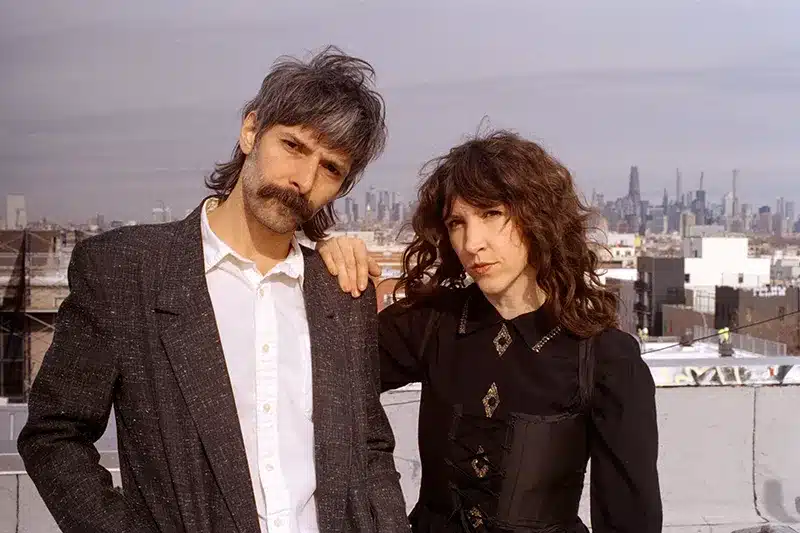
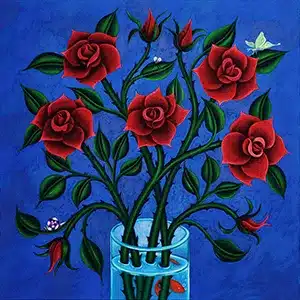
On Widowspeak’s new album, Roses, Molly Hamilton’s voice drips with melancholy, a bittersweet knowing that everything is impermanent. Guitarist Robert Earl Thomas, ever intriguing, is varied and precise, his rhythms segueing from the punchy to the grungy, his solos unfurling as a cross between George Harrison circa the Beatles’ BBC gigs, a speedy Kurt Vile, and an eclectically minded MJ Lenderman. The band as a whole remains hazy yet effervescent, murky yet with an Americana lilt.
If their last album, 2022’s The Jacket, exemplified their affinity for opaque atmospheres, Roses builds on the brighter tilt of 2020’s Plum. That said, the group’s signature moodiness remains uncompromised. Widowspeak are still Widowspeak, yet with a rangier bandwidth – the “dream” is present and accounted for, though this time around there’s more “pop” (always the trickier part of the dreampop equation).
“The Hook” launches with a melodic guitar intro. Hamilton sounds as if she just woke up after a toss-and-tumble night. While the singer clearly owes a debt to Hope Sandoval, with Roses, she moves beyond obvious comparisons, incorporating a distinct country cadence. Twangy guitar notes and warm drums complement a modish blend of “Dead Flowers”-era Rolling Stones and peak Mazzy Star.
The Americana references are not entirely new. 2015’s All Yours, for example, notably explored pop-country blends. With Roses, however, the diverse templates are more fully integrated. In “No Driver”, Hamilton could be auditioning to revamp Julee Cruise’s “Mysteries of Love” in a redo of Blue Velvet, though she stirs in a handful of southern charm. Thomas’s solo is arena rock delivered with punk urgency. “If You Change” recalls Waxahatchee at her sultriest. Hamilton lets her lover know that she’s not looking for perfection (“If you change, don’t change too much”). Thomas nails a soaring solo that would be apt in a Lower East Side club or on the main stage at Shaky Knees.
The title track turns up the benzo vibe, drifting toward slowcore. Hamilton teeters on the top of a crumbly staircase as she cranks the heroin/heroine charisma (“I want to be the one”). In “Angel Number”, the band navigate a post-1960s jangle. At the same time, the track radiates a liminal decadence à la Patrick Flegel, even if the latter exemplifies DIY energy whereas Roses ultimately occurs as strategically produced (by Thomas, who produced or co-produced Widowspeak’s last two albums).
“Still love you like it’s all brand new,” Hamilton purrs on “Soft Cover”, letting her partner know that she’s in it for the long haul. “Heaven Is Waiting”, meanwhile, resembles Widowspeak’s career-establishing work—spacious, hypnotic, even droney. “It’s a bitter pill / I’ll swallow it down fast,” Hamilton moans, referring to inevitable disappointments and anticlimaxes, the challenge of being stuck in one’s own too-tight skin. “Actor” addresses the way we each have our public personas and the person we go home to, that permanent guest who loiters in our head and taunts us when the lights go out. The instrumentation chugs along as Hamilton strikes a balance between a hushed moan and a heartland drawl.
With Roses, Widowspeak further hone their songcraft while again offering entrancing soundscapes. Additionally, they flesh out their Americana proclivities. In terms of melody, atmosphere, instrumentation, and vocals, Roses represents some of the band’s most moving work. While longing and ephemerality remain their primary muses, their dim rooms are now splashed with summer light. The roses, exquisite in that translucent vase, are just starting to turn.