
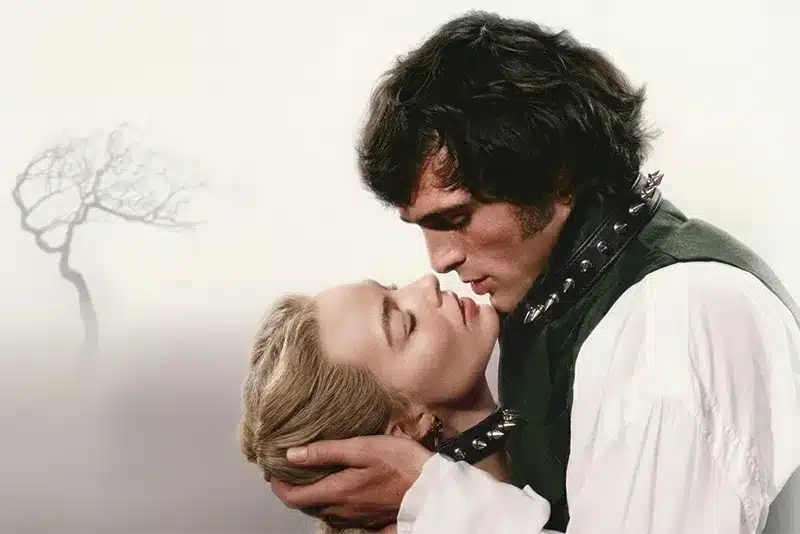
The 2026 release of Emerald Fennell’s “Wuthering Heights” provoked strong reactions from professional movie critics and casual viewers alike. In some ways, this polarizing discussion was not unexpected. Most adaptations, especially of beloved novels, face criticism upon release, particularly from viewers who want the adaptation to remain faithful to the source material. Fennell’s interpretation of Emily Brontë’s 19th-century novel, however, seemed to face even more intense vitriol.
Fennell defends her film in a 2026 interview with Vanity Fair, saying the book was “such a gargantuan masterpiece” that she couldn’t “possibly attempt to … touch its coattails. But what I could do, though,” she said, “was look at how it made me feel.” She addresses the quotation marks she applies around the film’s title, noting, “I can’t say that I’m making ‘Wuthering Heights.’ It’s not possible. What I can say is that I’m making a version of it.”
Even with these caveats, critics upbraided the film. Emily Van Duyne, writing for Literary Hub, compares the film to a “Brontë Birthday Bash” thrown by a teenager who’d been “giv[en]…a blank check” by “a wealthy Oxbridge don.” Harry Khachatrian, of the Washington Examiner, notes, “Under the flimsy pretext of ‘interpretation,’ Fennell reshapes one of the 19th century’s towering novels into something resembling garish fan fiction, calibrated to complement excessive glugs of cheap pinot grigio.”
Posts on Reddit and Instagram seem to agree. For instance, one Reddit user titled their post “Wuthering Heights – what tf was that?” They conclude, declaring they will “be watching Pride and Prejudice tomorrow to cleanse [their] eyes.” Benjamin D. Muir’s article for The Conversation begins with a quote from a Letterd’box review, “Emily Brontë died of tuberculosis 177 years ago, yet this adaptation is still the worst thing that has ever happened to her.” Another, on Instagram, simply posted a photograph of a hand giving the middle finger to the “Wuthering Heights” film poster. Vitriolic, indeed.
One character’s depiction, in particular, seemed to hit a nerve with viewers: Isabella Linton (played by Alison Oliver). Online, viewers responded strongly to the scene where Nelly Dean (Hong Chau), Catherine’s companion and confidante, arrives at Wuthering Heights, the ramshackle estate where the main characters Heathcliff (Jacob Elordi) and Catherine (Margot Robbie) grew up, and where Heathcliff returns to and resides with his wife, Isabella. Upon opening the door, Nelly sees Isabella on all fours with a dog collar around her neck.
Posting on Reddit, altrightobserver, shares a film still of this scene alongside the text “In Wuthering Heights (2026), there is an excruciatingly long pet play scene. This is a reference to the fact that Emerald Fennell should be criminally charged for desecrating Emily Brontë’s corpse.” In “What Wuthering Heights Did to Isabella Is Unforgivable – and Is Part of the Movie’s Wider Problem,” Laura Jane Turner writes that one of Brontë’s most tragic characters is “played more for laughs”.
Emily Brontë’s Dogs
Feminist scholars have observed that, in literature and popular culture, women are often equated with animals, domesticated, dominated, and sometimes even metaphorically consumed by their male counterparts. At first, Fennell’s depiction of Isabella seems to fall prey to these tropes. However, I argue that, in the spirit of Emily Brontë’s novel, Fennell uses animal imagery to directly engage with the source material, preserving both the characterizations and the themes that literary critics have identified in Brontë’s novel.
In her books, The Sexual Politics of Meat (1990) and The Pornography of Meat (2008), Carol J. Adams discusses the ways in which women are consistently equated in both advertising and popular culture with animals. The Sexual Politics of Meat opens with a collage of images in which animals, such as pigs and turkeys, are depicted as women. Adams makes the argument that linking animals and women can engender misogyny; if a woman is seen as something less than human, then it is easier to objectify and, perhaps, even violate her.
While we might hope that Adams’ observations are outdated, contemporary culture, unfortunately, continues to reaffirm this association of women and animals. For example, in Season 1 of the television series True Detective (2014), a female murder victim’s body is found kneeling by a tree with deer antlers on her head; in Halina Reijn‘s erotic thriller Babygirl (2024), a scene depicts Nicole Kidman’s character on all fours while the male lead (Harris Dickinson) lures her to him with a “treat” in his hand.
In 2025, Sabrina Carpenter’s album cover for Man’s Best Friend sparked controversy; like Kidman’s character, Carpenter is depicted on all fours, while a partially concealed male figure holds her hair in his fist, implying he’s holding her on a dog leash. Finally, in its Season 3 premiere, Sam Levinson’s Euphoria includes a scene in which Jacob Elrod’s character, Nate, walks in on his wife, Cassie (Sydney Sweeney), who is creating online content dressed as a “sexy puppy”. “You’ve been a bad, bad dog,” Nate says; she responds, “Woof. Woof,” as he pulls her toward him by the leash. Equating women and animals, it seems, remains a popular trope in the 21st century.
When examining Isabella’s scene in this context, the problematic elements are obvious. However, when viewed as one of many scenes Fennell crafts to comment on the behavior of nearly all her characters, it reads a bit differently. There is a breadth and depth of literary scholarship about the role that animals, particularly dogs, play in the work of the Brontë sisters and, more specifically, Emily.
Writing for Victorian Studies in 1984, scholar Barbara Munson Goff acknowledges, “Virtually all critics of Wuthering Heights have addressed themselves to the rhetoric of animality in the novel, finding in the trope a structural device, a feature of characterization, a clue to Brontë’s renaissance sources, an element of her philosophy of nature, and so on.”
Subsequent scholars such as Lisa Surridge (Brontë Society Transactions, 1999) and Ivan Kreilkamp (The Yale Journal of Criticism, 2005) have also written about the role that animals play in the 1847 novel. More recently, in the introduction to her essay for the anthology, “Animals in Victorian Literature and Culture” (2017), Susan Mary Pyke argues that Brontë’s “relational representations of the equine and canine” anticipate the contemporary animal rights movements.
Emerald Fennell cements the comparison between humans and animals with the opening scene of “Wuthering Heights”, which strangely parallels a later scene of butchery. In this opening scene, a young Catherine (Charlotte Mellington) and Nelly (Vy Nguyen) attend a public hanging; they watch the hooded man swing from the gallows, and they hear the man’s gasps as he dies, along with the squeaking of the contraption on which he hangs.
Fennell later replicates this imagery and audio in a scene where a pig is being slaughtered in the courtyard of Wuthering Heights. The pig, like the man, is hanging; its body is suspended a few feet above the ground as it’s being butchered. Some of the sounds from the earlier scene are repeated; the pig squeals, and there is the persistent, disturbing creak of the rope.
Cultural critic Stevie McCulloch, in his post, “Where Are All the Dogs? A Pet-Lover’s Take on ‘Wuthering Heights’ (2026)” for Waggel, notes that the presence of animals in this film, save for Isabella’s small dog and the estate horses, is notably reduced from the number of animals that originally appear in Brontë’s novel. However, she also notes that “the role animals once played [in the novel] has been absorbed into the human characters themselves.”
For Fennell, animals become symbols throughout her film. Early in “Wuthering Heights”, in the scenes where Catherine, Heathcliff, and Nelly are children, there is a conflict between Catherine and her father, Mr. Earnshaw (Martin Clunes). In this exchange, he calls her a “hellcat”. Later, when Catherine gets stranded at the neighborhood estate, Thrushcross Grange, with a sprained ankle, he calls her “a clever little cat”, implying she’s using her time there to beguile the eligible bachelor, Edgar Linton (Shazad Latif). Isabella calls Catherine “a dog in the manger” when Catherine scoffs at the idea that Heathcliff could ever be interested in Isabella.
Indeed, Heathcliff (Owen Cooper) is consistently characterized as a dog. When first introduced to viewers, a young Heathcliff trails behind a man assumed to be his father, almost like a dog; the man prods him along, aggressively urging him to hurry. A few scenes later, a drunken Mr. Earnshaw brings Heathcliff home, declaring to the servants that Heathcliff was suffering abuse at the hands of his father and will now be the ward of Wuthering Heights. Catherine declares she has named the boy, and Mr. Earnshaw delightfully exclaims, “He shall be your pet.”
Throughout Fennell’s film, we see Heathcliff hiding under his bed like a frightened dog. In the scene in which Heathcliff takes the blame for missing Catherine’s father’s birthday to spare Catherine any punishment from her father, Mr. Earnshaw gives him a beating. As viewers, we are on the other side of the door with Catherine and Nelly, listening to the punishment taking place behind it. We hear shouts of “Come here, you dog” and “Hold still, you dog” as well as Mr. Earnshaw’s commands for Heathcliff to bark. Heathcliff even thinks of himself in these terms; he promises Catherine, “I can follow you like a dog to the end of the world.”
Fennell also includes more subtle comparisons between humans and animals in her interpretation of the story. At one point, when Catherine attempts to visit Heathcliff in his attic room, she peers through the floorboards to see two of Wuthering Heights’ servants, Joe (Ewan Mitchell) and Zillah (Amy Morgan), meeting up for a tryst in the barn below. Joe beckons Zillah with the crack of a whip; Zillah willingly puts a horse bridle over her head before the two have sex.
The scene where Nelly prepares Catherine for her wedding to Mr. Linton begins with an extreme close-up of the back of Catherine’s corset, its ribbons criss-crossed against her damp skin. Most obviously, the criss-crossed ribbons recall the markings on Heathcliff’s back from the beating that he received from Catherine’s father. They also strangely evoke the imagery of an animal being trussed for roasting.
The scene sequences at Thrushcross Grange are especially rich with this imagery. A variety of props represent Catherine’s confinement. In the montage of her early days at the Grange, we see Catherine walking the halls, tapping on the glass of a taxidermied lamb, feeding a fish encapsulated in a grand, glass bowl, set upon one of the pillars of the outside porch.
While the scene is cut with moments of frivolity – the inhabitants of the Grange playing party games, painting, and eating – as well as scenes of Edgar and Catherine having sex, the montage is undercut by the inclusion of Charli XCX’s song “Chains of Love” in which the chorus sings: “Shattering like glass / It’s the breaking of my heart / The chains of love are cruel / I shouldn’t feel like a prisoner / My face is turning blue / Can’t breath without you here / The chains of love are cruel / I shouldn’t feel like a prisoner.” At the end of the montage, there is a close-up of a fish captured in aspic; the camera focuses on Catherine’s finger slowly making its way through the squishy jello into the fish’s mouth while Edgar and Isabella argue in the background about whether or not Isabella should be allowed to attend a hanging.
Margot Robbie speaks to this symbolism in a post by@imdbpro on Instagram. When asked about props that inspired her character, she describes “A lot of taxidermied things at the Grange.” She continues, “And so when Cathy’s kind of entering her life and having this realization that this thing, you know, this situation that she thought was going to kind of save her, actually has caged her. And, she’s looking at these taxidermied animals in these glass boxes. And I think she’s having the realization like, ‘Oh fuck. That’s me.’”
These scenes at Thrushcross Grange underscore Catherine’s isolation there and her unhappiness with her marriage. Heathcliff’s fear and isolation when he first arrives at Wuthering Heights as a child are also expressed in such ways. Interestingly, Fennell also includes a scene between Heathcliff and Catherine that eerily parallels the later dog-collar scene with Isabella. In Heathcliff and Catherine’s last sexual encounter before Catherine breaks off their love affair, it is Heathcliff who is on all fours, crawling toward Catherine, snapping and snarling at the air.
Emerald Fennell’s Dogs
When examined in connection with one another and across the whole of “Wuthering Heights”, these animal imagery moments become a way for Fennell to upend, not reinforce, Adams’ theories about women / passive / prey and men / active / predator. In turn, these “relational representations” between animals and humans, as Susan Mary Pyke describes them, become a way for Emerald Fennell to honor the characterizations and themes of Brontë’s novel.
In the introduction to his 2015 essay, “‘Well, we must be for ourselves in the long run’: Selfishness and Sociality in Wuthering Heights”, Victorian literature scholar Thomas J. Joudrey summarizes the critical response to the release of Wuthering Heights; he writes that critics “were … shocked and confounded by a tale of unchecked primal passions, replete with savage cruelty and outright barbarism … at the epicenter of its moral rot, they identified the vice of selfishness.”
Brontë’s novel is filled with unlikeable characters, flawed individuals who, time and time again, hurt one another, physically and emotionally. By likening both the female and male characters in her adaptation to animals, Fennell has cleverly integrated the animal metaphors from Brontë’s novel into her film.
In the previously discussed essay by Susan May Pyke, there is a subsection entitled “Winking at Violence”. In that section, Pyke notes two key moments in Brontë’s text where a character winks after enacting violence. These moments of vile behavior are not particular to that singular character; rather, these acts are just some of many in Brontë’s novel.
Rather than condone the violence, Brontë is questioning both the violence itself and the behaviors that produce and enable it. It’s interesting to note that a wink plays an important role in Fennell’s adaptation of Wuthering Heights, as well. In Isabella’s dog collar scene, when Nelly asks her if she’d like to come home to Thrushcross Grange, Isabella responds, “I am home,” and then, a beat later, she winks.
One could read this wink as self-awareness. In other words, Isabella acknowledges her complicity in the world she and Heathcliff have created. You could read this wink as one of Fennell’s own. Her adaptation, through props (Catherine’s skin room), costumes (the moonlight dress), or narrative elements (such as this “pet play” scene with Heathcliff and, later, Isabella), all exhibit Fennell’s interpretation of the novel; the title of her film is, remember, in quotation marks.
In that spirit, then, I invite viewers to think about Emerald Fennell’s “Wuthering Heights” not as a literal translation of the novel, but as embodying Linda Hutcheon’s definition of adaptation in her 2006 work, A Theory of Adaptation: Adaptation, she argues, is “a derivation that is not derivative – a work that is second without being secondary. It is its own palimpsestic thing.”