
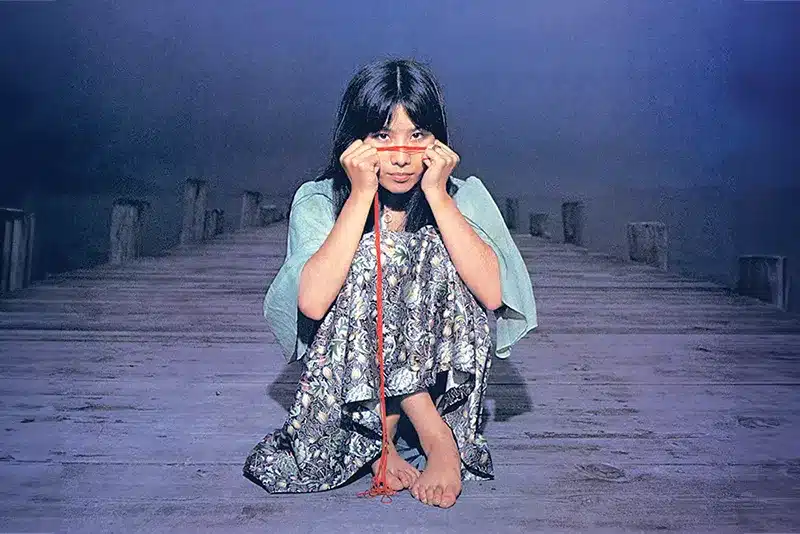
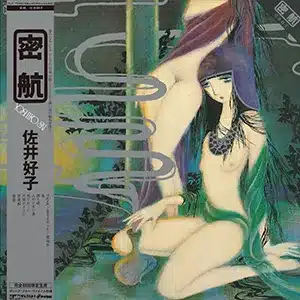
The creative world of Yoshiko Sai is a multimodal thing. It is not limited by strict adherence to certain genres or media, but is instead as expansive and as variable as her imagination. Interested in drawing, reading, and making music from childhood, Sai hit an unexpected turning point in the early 1970s when illness left her bedridden for a year. She found solace in surreal literature and the craft of poetry, which she quickly translated into songwriting. Between 1975 and 1978, she released four albums of original music, most of which were accompanied by her own artwork, all strange and gorgeous.
Parisian label Wewantsounds released Sai’s debut Mangekyou back in 2024 and now returns with an internationally available reissue of her 1976 sophomore release Mikkou, which she glosses as “secret passage” but which can also be more roguishly translated to “stowaway” or “smuggling”, connoting ideas of willful nomadism and defying borders. Certainly, large-scale movement was on Sai’s mind as she wrote this album, which she has discussed as being loosely thematically bound by the idea of the Silk Road.
That comes through in both the instrumentation and the lyrics. Tabla, sitar, dulcimer, guitar (classical and electric), flute, cello, vibraphone, electric bass, and piano all come and go in different combinations throughout the album, suggesting cross-continental exchanges.
This fluid foundation is the perfect counterpoint to the sound at the heart of Mikkou: Yoshiko Sai’s powerful voice. Flexible in terms of the styles she takes on, Sai’s voice has an impressive range and a particularly soulful low end that make her a compelling leader across shifting soundscapes of folk, funk, and pop. She is equal parts R&B diva and neo-folk balladist on bluesy “Haru”. She purrs and soars across the sensuous, cello-laced dreamscape of “Nemuri No Kuni”. Over the bouncy synths and strings of “Tenshi No Youni”, her delivery offers a melancholy edge that suits the song’s lyrics, which express the frustration of a neglected wife and new mother pining desperately for freedom from an inequitable life.
Ultimately, freedom is what Mikkou is all about: the desire for it, the need for it, the vastness it offers. Whether it only comes in sleep, as in the lonesome of soft blues rock track “Hyouryuu Sen”; in isolation, as in “Hito No Inai Shima”, a haunting and spacious track that imagines an island without people; or in the wasteland, as in shimmering “Kinu No Michi”, in which electric sitar rises as a mirage; freedom is aspirational, a fantasy that may yet be in reach.
Mikkou is a vision realized. Not by a single person, of course; producer Isamu Haruna, arranger Kuni Kawachi (of psych rock group Flower Travellin’ Band), accomplished guitarist Masayoshi Takanaka, and several brilliant session musicians are absolutely necessary to bring Sai’s poems to multidimensional life. It is, though, Yoshiko Sai herself who emerges from the mix as a true luminary unlike any other, holding together an eclectic palette with unshakeable artistic sensibilities and a truly fathomless mind. This is a work well worth its reissue.