

Oftentimes, the most interesting films are released during periods of acute cultural repression. One thinks here of Payal Kapadia’s All We Imagine As Light (2024), which the Film Federation of India neglected to promote for the Academy Awards for being a “European film made in India”; in other words, for not fitting in with the narrow agenda of the current ruling party. At least 2025’s Songs of Forgotten Trees has attached to it the name of renowned director Anurag Kashyap, whose credit as executive producer is likely to attract mainstream viewers.
Indeed, it is under this very climate of censorship that India has seen some of its most daring releases of recent decades. The past two years alone include Karan Kandhari’s comedy Sister Midnight (2024), Sandhya Suri’s thriller Santosh (2024), Rohan Kanawade’s romance Cactus Pears (2025), and Payal Kapadia’s drama All We Imagine as Light, which Anuparna Roy’s debut feature, Songs of Forgotten Trees, will inevitably face comparison with, for it too shares a young female debut director, an urban Mumbai setting, and charts the lives of two women battling the alienation of the vast metropolis.
All these films face problems with the Central Board of Film Certification, India’s state-run censor board, but the real misfortune lies in the fact that this symbiotic relationship between the state suppression of art and vibrant indie film productions has resulted in the latter’s lack of screenings in India itself; they are instead shown mainly in select arthouse cinemas across the West. One is reminded here of Saim Sadiq’s marvellous Joyland (2022), which was banned in Pakistan upon release (and how Shashi Tharoor’s warning that India must not become a “Hindu Pakistan” rears its ugly head…) or Sandhya Suri’s Santosh, which was removed at the last minute from the PK Rosy Film Festival.
Set in Tamil Nadu by filmmaker Pa Ranjith, the festival showcases rare and radical films and is named in honour of the Malayali actress PK Rosy, who was supposedly low-caste, which marked her out for violent retribution in the 1920s by upper-caste men who were incensed that she was acting at all, let alone playing an upper-caste woman. That Santosh, a film that features harrowing scenes of caste discrimination in a bid to show society how it continues to behave, has been blacklisted is a tragedy. Apart from a small dialogue early on in which a prospective bride is asked if she is a high-caste Brahmin or not, however, Songs of Forgotten Trees is not concerned with critiquing caste or the state (one hopes that this may aid its survival in the distribution circuit), but the specifically female condition in India’s wider patriarchy.
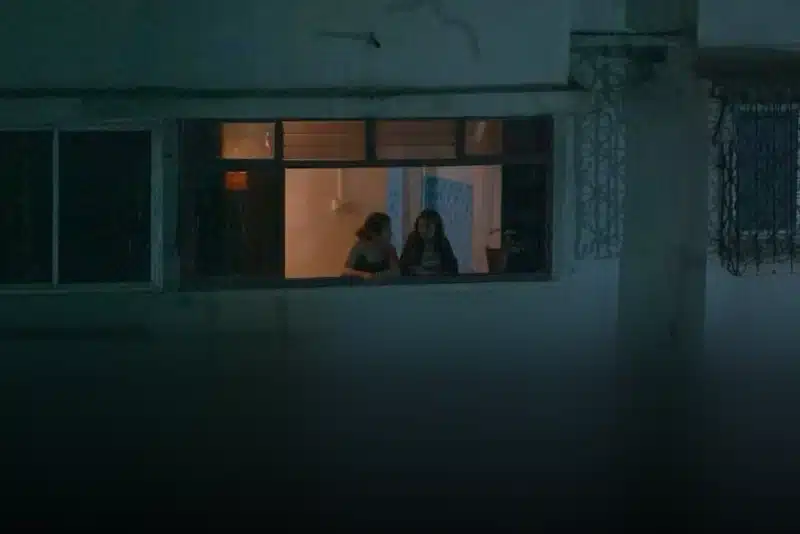
Thooya (pronounced thoo-waa) is an aspiring actress and sex worker on whose bedside table we see John Rawls’ 1971 political philosophy, A Theory of Justice, and whose English-speaking skills, in a city where this is prized currency, mark her out from the more impoverished sex workers of nearby Kamathipura or Budhwar Peth. She is joined in her flat, in which she meets her clients, by roommate Lisa, an IT sales exec (Roy’s former profession from which she saved six years’ worth of salary to fund this film). Together they are free to roam the space of their flat, to explore each other’s pasts and desires; outside, however, their positions in society render them restricted, even controlled, as they yearn to make sense of their lives.
In India, long, intense Work From Home cultures (Infosys Founder and father-in-law of Rishi Sunak, former Prime Minister of Britain, Narayan Murthy, famously encouraged a 72-hour work week) have meant that for many white-collar workers the limits of their four walls are the limits of their city, and therefore also the limits of their world. Their primary means of exploration is the promise of limitless adventure through the cyberspace contained in their phones and laptops, represented by Lisa’s unfulfilled wish to explore Mumbai and its sea.
As in All We Imagine as Light, Anuparna Roy rejects the colourful, riotous Bollywood fantasy of Mumbai in favour of an anonymous metropolis, eerie in its repetition of stained high-rise architecture, its endless rows of nameless human beings stacked upon each other in blocks. It is in this monotonous space that Thooya and Lisa bond and attempt to connect, that their lives gain colour; but any connection outside this is stunted by their lack of access, by the patriarchal mode enforced upon them, and by the limits of being a lower middle-class female.
Early Indian communist theorists hoped that huge industrial cities such as Mumbai, with all the caste-less, religion-less mingling they entail, would herald the potential for an enlightened proletariat capable of revolution. The Mumbai we see in Songs of Forgotten Trees, however, is the opposite: community is replaced by anonymity, connection is replaced by loneliness. The endless flat complexes of people living with each other with no commonalities or connection are what poet, author, and politician Aimé Césaire would have called “a disembodied universalism”. Forbidden to speak her mother tongue, Hindi, and just like her roommate, spoken down to by men who feel they are owed her access, Lisa especially is surrounded by digital presences to whom she must present a rehearsed, industrialised version of herself, to whom her true self can never be revealed.
Anuparna Roy avoids the dreamlike, mesmerising imagery of Payal Kapadia’s Mumbai, preferring a plainer, tonally muted palette. It is a brave choice to spurn the sleek sterility of the modern digital image. Roy’s use of 4:3 aspect ratio alongside a minimalistic 1-shot approach to coverage provides a heightened sense of reality to the series of images we see. Though we know we are watching fiction, we feel we are watching real life. These images come together as a bunch of impressions of the daily (and nightly) lives of Thooya and Lisa, connected by their shared outsider status as bachelorettes, as city dwellers, and importantly, as women.
Outside of its finely charted visual aesthetic, Songs of Forgotten Trees’ bare 77-minute runtime is perhaps inadequate to properly explore its set-up. Where are these characters going? What is the outcome of their connection? Has the plot been taken to its limits? Are we given enough to get a picture of a full life, to really feel its presence?
Many independent releases in India over the past few decades have pushed the boundaries of Indian filmmaking. Yet rarely do these films push the boundaries of filmmaking itself. Within the Indian context, they are new and fresh and even radical, but glimpsed in a wider setting, they sometimes lose their edge. What remains after this? Amongst other things: the story. Songs of Forgotten Trees may not have quite enough information about contemporary life in Mumbai, as do some of its counterparts, but nevertheless, it is a fine addition to India’s burgeoning culture of independent films.