

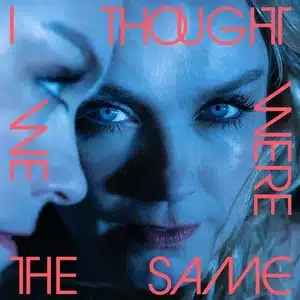
In “Reevaluating You”, the seventh track on Ane Brun’s I Thought We Were the Same, the singer asks, “What is the opposite of trust?” She answers, “It’s not doubt… the opposite of trust is anxiety… the fear that closes us off from others, even from ourselves.” She goes on to elaborate, “In anxiety, we seek certainty before we commit ourselves. But in trust, we commit ourselves without certainty… trust won’t appear until we find ourselves defenseless”.
This theme, of course, runs through literature, psychology, and religion: the idea that there’s no substitute for the “Kierkegaardian leap”, a psycho-spiritual movement beyond rational and/or logical thinking. In Brun’s new work, the above-quoted lyrics serve as a mid-project explication as she explores matters of love, loss, and identity.
Throughout I Thought We Were the Same, Brun observes how romantic relationships frequently begin and end with fear—the fear of being alone and, in turn, the fear of commitment. More broadly, she explores how fear governs much of human life and how we instinctively gravitate toward safety. However, true freedom and meaningful love tend to arise and flourish when we relinquish our illusions of control.
If previous work, including 2020’s captivating How Beauty Holds the Hand of Sorrow, showed Ane Brun tilting toward folk sounds or blending folk and pop approaches, here Brun lands consummately in the pop domain, each track featuring lush orchestrations and vocals that land as both heartfelt and theatrical. “Hold Me”, for example, is built around a well-layered and beat-driven arrangement. Brun’s voice is evocative yet restrained, sultry yet controlled, as she tries to make sense of a relationship that is more painful than fulfilling, even if the “fantasy” still holds weight.
“How Can I Hold Your Hand” similarly captures Brun pondering how to navigate feeling drawn to someone when those feelings might not be reciprocated. Can she risk taking the initiative, expressing herself when she doesn’t know how the other person will respond? Buoyed by brushy percussion and sweeping instrumentation, Brun displays her emotional and technical range, gliding from lower to higher pitches, segueing through states of palpable doubt and confidence.
“Eat the Fruit” fuses melodic hooks, a rich vocal, and a riveting beat. One imagines bodies swaying under a starry sky—beauty, change, liberation from ego and the confines of personality, oneness with nature. On the other hand, one can visualize a party of MDMA-takers trancing out in a downtown apartment, surrounded by city sounds. In this way, Brun merges the prime-time aspirations of an Adele with the more indie, eclectic stance of an artist such as Susanne Sundfør.
The austere yet weighty instrumentation on “Certain Moments” conjures Peter Gabriel‘s 1986 duet with Kate Bush (“Don’t Give Up”). “Where does the road go from here?” Brun asks, facing the inevitability of change and impermanence. Her voice is as supple as ever, as she emerges from confusion, realizing that living openly and with curiosity in the moment is the best way to practice presence. She opts for the “full catastrophe”, to quote Jon Kabat-Zinn, rather than living the protected life (though, obviously, this isn’t a one-time decision, but has to be reaffirmed constantly). String sounds come and go, adding gravitas.
With “Two in This Story”, Brun is at her most diaristic. “Was it connection really / Or was it just a feeling / An illusion?” she considers, conveying a willingness to be honest, to learn about herself and her relational proclivities. Moving between minimal and busier instrumentation, Brun evokes a blend of confessional Florence Welch and inquisitive Cassandra Jenkins. Still trying to dissect a breakup, the singer begins to make peace with the fact that the relationship is over, and that she and her ex contributed, each in their own way, to its demise. We all think or hope that our unions will last forever, but priorities morph. Incompatibilities surface. Discontents gain traction.
“Can We Go Back?”, meanwhile, captures that reflective moment of doubt, when the relationship that ended, and probably needed to end, suddenly looks ideal: “I always felt safe… that you would be with me.” Brun crashes into nostalgia, as she concludes, “I always felt like me. I always felt so free.” Snarly verses that vent post-break-up consternation are contrasted with relaxed, spacious choruses that suggest removal (tinged with anger). Brun models how we bargain with the universe, diving into rationalizations and magical thinking when loneliness becomes unbearable.
“Everything you want can happen”, Brun sings on the closer, “In These Waters”, coaching herself (and us). Fulfillment, or at least some degree of self-actualization, is our birthright. We redeem ourselves by accepting who we are and moving forward accordingly. Regrets drop away; clarity ensues. As therapists and self-help books have been telling us for decades, we don’t need anything (or anyone) to complete us.
With I Thought We Were the Same, Brun’s voice is exceptionally nuanced, her lyrics distinctly self-revealing and interrogative. The album’s arrangements support Brun as she nudges the boundaries of pop, refining the motif of tragic romance and expanding the persona of the heartbroken lover. Across 11 compelling tracks, Ane Brun is notably introspective and often philosophical, while reveling in elegant songcraft and a sublime production MO.