
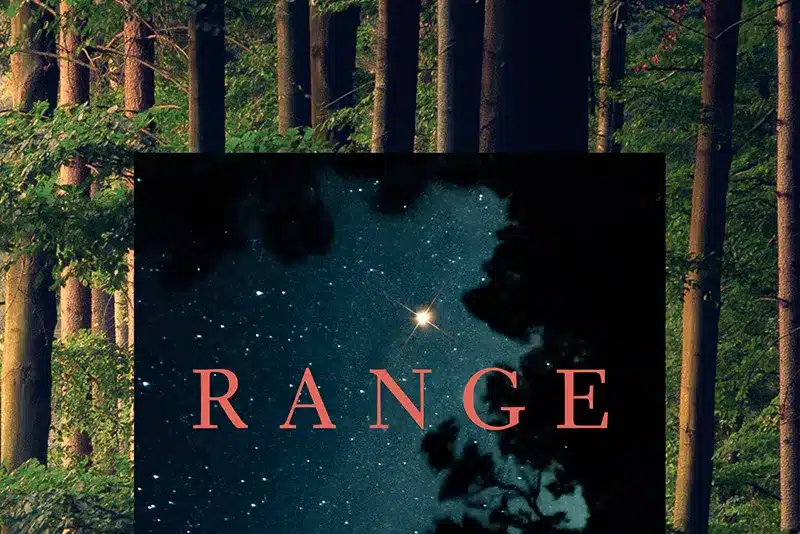

Dorthe Nors’ latest novel, Range, written in Danish and to be published in English in August 2026, presents a tale embodying a fundamental duality: the earthbound and the celestial.
Gunn Haven, an astrophysicist studying the origin of the universe, is taking a leave of absence from the Institute in Copenhagen, where she teaches. She arrives in a remote area of Denmark, where, due to the lack of the Institute’s urban light pollution, she hopes to continue observing the night sky both through her telescope and while lying on her back in the field adjacent to her rustic house.
Entering the village, Gunn hikes past abandoned farmhouses, through woods, and game-hunting grounds. “New to the area, but already she knew the least movement near the shooting stands, or bait sites might activate various game cameras.”
Sure enough, she is almost immediately confronted by a menacing local, Krista, an overbearing, battle-clad woman in full hunter’s camouflage, who assumes a stance and films Gunn with her phone. “This is private property,” Krista declaims, “the road ends here.” There follow repeated encounters with Krista, including one in which Gunn is both spat upon and pummeled to the ground.
Thus is the astrophysicist introduced to her rural reality. She becomes enmeshed in a web of local relationships (finding a For Sale sign outside her house and a dead bird in her mailbox). Brit, a hairdresser, serves as Gunn’s source of information about the neighbors, with whom Gunn finds herself having tense conversations, real and imagined. Brit has a reticent teenage daughter, Jenny, whom Gunn takes under her wing, introducing her to the wonders of the night sky and the Earth’s place in the cosmos, hoping to convince her to change her lack of ambition and continue her education.
Gunn explains that she is “trying to capture and examine light from the oldest galaxies… by looking for GRBs. That’s gamma-ray bursts.” These are jets of radiation emitted during the death throes of certain types of collapsing or colliding stars. Gunn tells Jenny that because light and gamma rays travel at finite speed in the vacuum of space, viewing distant celestial bodies is literally looking into the past. She intrigues Jenny by explaining that looking through a telescope at an object a million light-years away is literally seeing it as it existed a million years ago—viewing the most distant objects is a way to see the earliest moments after the creation of the universe.
Gunn describes herself as an “archeologist of light”, telling Jenny that “working in this field…requires tremendous ingenuity…, minutely analyzing the last breaths of the dying, trying to find in them the reason why they were born in the first place.”
In contrast to the celestial, Gunn becomes immersed in the terrestrial details of local life, which she assumes are regulated by laws of nature just as cosmic bodies are. Gunn often thinks to herself, “There are rules for that,” in various situations with neighbors.
“And that arsehole of a neighbor had taken his knife and dug out the eyes from one of the [slaughtered] cows, put them in a freezer bag and given them to Karen. Since she thought they were pretty. Because you can’t have feelings for the animals, that was a rule.”
Range is a story of suspension between two realms, one on a granular day-to-day scale and one whose scale is incomprehensibly vast. Appropriately, the term “range” in Danish, as used by Nors, is “raekkevidde”, meaning “reach, scope or expanse”. Gunn exists in a superposition of states, each with its own scale and rules. Each has its range. Each has its secrets.
Dorthe Nors’ writing style is dense and compressed, heavy with interiority and experiences, real and imagined. While at times living among the locals and at times living among the stars, attempting to adopt a persona appropriate to each, Gunn lives always in her head.
In constructing her tale, Nors is cagey about doling out important facts, lifting the reader’s veil of ignorance incrementally and often returning to fill in gaps. This recursive technique, which can build reader engagement, can also, at times, shroud her story in a layer of opacity to the point where passages can appear cryptic and awkwardly structured.
Reading a work in translation can raise the question of whether the issues lie with the writing or the translation. However, Dorthe Nors’ writing, both astral and terrestrial, is beautiful and at times poetic; in the case of this eminent Danish author and award-winning translator, Caroline Waight, the conclusion must be that the intriguing but sometimes frustrating narration is the result of expert authorial decision-making.
It is known that there are three coexisting yet fundamentally different scales, each with mutually exclusive rules, that describe the singular and seamless universe. At the smallest scale, one set of rules applies (quantum physics, originally elaborated by Niels Bohr and others); at the everyday scale, a different set of rules governs (exemplified by the work of Isaac Newton), and a third set of rules (general relativity, explicated by Einstein) works at the cosmic scale. In this worthy novel, Dorthe Nors grapples expertly with two of these ranges. She is adept at the difficult task of making us feel at home in both.