
The 2026 film season has been strangely cluttered with stories of dangerous men pursuing their dangerous ambition at the expense of the public, or, more appropriately, the users. Danny Boyle’s Ink, Lance Oppenheim’s Primetime, Aaron Sorkin’s The Social Reckoning, and now, after much of the industry evaded it like the plague, Luca Guadagnino’s Artificial. The four films, releasing weeks from one another, steamroll cautionary tales about what happens when men set out to control the public to obtain power.
In 2026, these tropes feel tired, but the execution varies greatly across the films: Ink narrates the history of tabloids envisioned by maniac businessmen, Primetime unspools like a maniac’s fever dream, The Social Reckoning hints that a maniac billionaire might still face justice, and Artificial is a straight-faced horror film. About maniacal men, of course, in this case a bevy of them.
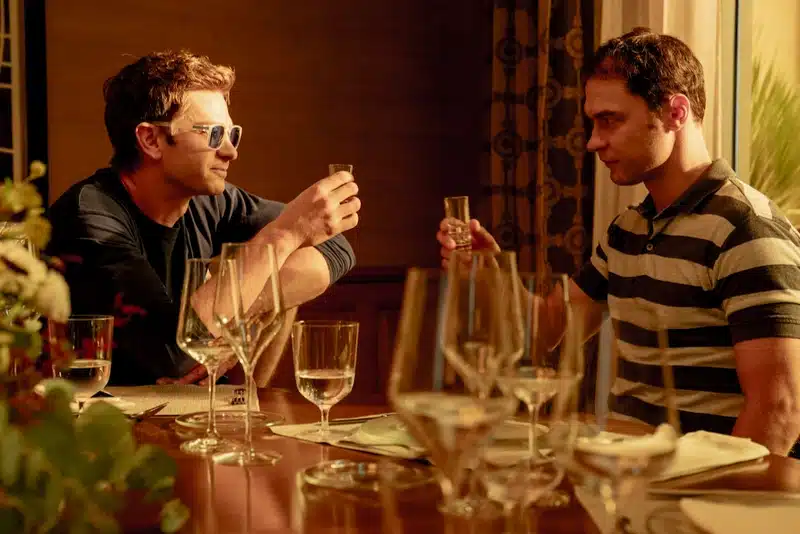
Written by humorist and SNL veteran Simon Rich and starring a never-better Andrew Garfield as OpenAI’s chief demagogue Sam Altman, formally speaking, Artificial, which premiered at the BFI London Film Festival, is a story about the 21st-century race for the so-called “artificial general intelligence”, culminating in the rise of OpenAI and the socioeconomic turmoil brought about by its cofounder, Altman. The film’s main perspective, however, draws on Ilya Sutskever (a fantastic Yura Borisov), a math wunderkind and doe-eyed ingenue who, you know, just wanted to change the world or whatever, but inadvertently made a pact with the Devil to achieve this.
It is 2003, and Sutskever, a 17-year-old undergrad, barges into the classroom of the future Nobel Laureate Geoffrey Hinton (a typically great Mark Rylance) to seek an assistant position in Hinton’s work on a model of artificial intelligence. In a comeuppance sequence we’ve seen one too many times, Hinton dismisses Sutskever, only for the prodigy to barge back moments later to conveniently draw up Hinton’s research oversights on a board.
We are made instantly aware of Sutskever’s generational genius. This guy can help build something colossal. Something that, it is implied, can be disastrous if it falls into the wrong hands.
From the very next moment, we are treated to an overview of all the wrong hands that Hinton’s and Sutskever’s AI work could (and did) fall into—including the hands they threw themselves in. After building a workable model, in 2012 the computer scientist duo put it up for auction, ending up at Google for $20 million. Their noble attempts at doing independent research within the conglomerate that perfected surveillance capitalism are thwarted by the likes of Chris O’Dowd’s John, a top executive who doesn’t see how Google can capitalize on AI.
There is someone who can, though. The Silicon Valley hotshot Sam Altman (Garfield) and his buddy, Elon Musk (a hysterical Ike Barinholtz). Before the end of 2015, Sutskever leaves Hinton behind at Google Brain to found OpenAI with Altman, Musk, and a handful of other blowhards. Months later, the future founder of Anthropic, Dario Amodei (Will Angus), joins them from Google. You get the picture.
As the OpenAI team races with the invisible fist of the free market to create a usable model of AI (we have to be satisfied with the broad strokes here), moral and ethical qualms emerge. Alliances are forged and broken, but the wheel keeps spinning until the bitter end, arriving at the apparent truth that few of these figures care about science. Of the many talented grifters, only Altman shows consistency in his manner; he never feigns benevolence.
Make no mistake: Artificial is about AI as much as The Social Network is about Facebook, which is to say, not much. It is, laudably, considerably more interested in the social mechanics that bring monstrosities such as ChatGPT to life, deriving its tension from the human relationships at the heart of any business venture. Sutskever, idealistic and cerebral, and dignified Hinton alike, are thus pitted against Sutskever’s faux bestie Altman and his insatiable patron Musk. Everyone else, including the talented OpenAI Chief Technology Officer, Mira Murati (Monica Barbaro), is slowly swallowed by this perilous duality.
Trailed by Rylance’s restrained Hinton and Barbaro’s skeptical Murati, both of whom serve as the voice of reason and, perhaps, conscientiousness, Borisov and especially Garfield give Artificial their all as doomed allies Sutskever and Altman. Their differences in perspective and motive make the incessant back and forth about the nature of both AI and humans an edge that is at the same time hilarious and deeply frightening.
The entire cast, including Ike Barinholtz’s unhinged Musk and Cooper Hoffman’s OpenAI board chairmen Greg Brockman, glides through the ethical and political dilemmas of developing AI vigorously; that they all happen to disagree on most things, ceaselessly pushing their own agenda in myriad juvenile and whimsical ways, makes Artificial a thoroughly entertaining watch. Rich’s playful, yet serious screenplay gets verbose at times but never stalls the numerous developments preceding Altman’s emergence as the (sadly, no spoilers here) tech bro top dog and a shadow looming over the free world and its freer-than-ever markets.
Luca Guadagnino, known for his intense focus on the manifestation of the psychological in the physical, directs friskily, with frequent close-ups, sharp cuts, and fluctuations in speed and angles. His insistence on turning an otherwise chamber piece into an overstated vanity fair anchors the viewing experience deftly, making camerawork a proxy for the delusions of a “dynamic work environment” these boys thrive on.
Never flinching from the gritty or grotesque, in Artificial, Guadagnino thus reverts the impersonal algorithms and skyscrapers that inform all business stories to their fundamentals: the awkward, eager, sweaty, obnoxious human bodies that can barely sustain exhilaration at the mention of prosperity, however skewed their view of it. The 140-minute runtime flies by, and most of the characters’ act-outs and freakouts feel earned, not to mention spicy.
Overall, Artificial offers a compelling, urgent, and suitably cinematic tale in which all top creatives have a blast flexing their chops without ever losing sight of just how distressing the tale is. The slow but steady shift from a Hollywood striving boy docudrama, through farcical black comedy, to deadpan psychological horror, yields marvelous results, in no small part thanks to Garfield’s insanely disturbing portrayal of Altman as a demonic presence, hard at work to normalize fraud, lies, and exploitation as cornerstones of the contemporary IT industry.
Moreover, one of Artificial’s greatest accomplishments is its baring of both sides of the entrepreneurial aesthetic spectrum as neoliberal ideologies, morphing into a (work) ethic that inevitably makes greed and manipulation appear desirable. Masked as either swanky, breezy “ambition” (Altman) or earnest, impersonal “action” (Sutskever), these elements of “business development” coalesce into a monolithic worldview in which it is always better to ask forgiveness than permission. It is a terrifying debunking of the myth that business is or can be an honest person’s endeavor in a system predicated on malfeasance.
Artificial‘s Data Center
While it would be naive to compare Artificial, a narratively pointed feature, to the monumental The Social Network, which miraculously digests the entirety of (the US’s) social philosophy, its morale explains beyond doubt why Amazon MGM Studios dropped it. There is little surprise in this film becoming a pariah for the entire industry until NEON unexpectedly stepped in to spice up their awards push. Contradictory accounts from industry insiders and media like Variety, where the former claimed that Artificial previews didn’t “screen well”, the latter reporting the opposite, only underscore what we already knew: the powerful deeply dislike seeing themselves portrayed in a bad light, especially as clowns.
Ironically enough, therein lies the only substantial problem with Artificial. After all is said and done, the film isn’t sufficiently critical of these monsters. The choices to go heavy on comedy, make the direction flamboyant, and paint Elon Musk as a pathetic poser are all on point, but the simple horror denouement, which occasionally relies on our preexisting understanding of the topic, isn’t enough.
While Artificial doesn’t fall short on indictment (with generous help from Garfield, who plays Altman like a postmodern psychopath), much of the film rests on a dichotomy between the genuine and, well, artificial, the caring and the callous, even the feminine and the masculine. All the while, there remains a clear distinction between those who want to “do research” and those who want to get ahead, those who want to “work” and those who want to profit. Unfortunately, the biographies of these very real people tell us a different story.
Artificial uses the character of Ilya Sutskever to give us a half-Faustian, half-Ariel-the-Little-Mermaid narrator trying to resist evil and its temptations, but real-life Sutskever is today more than happy to take $5 billion from the militant anti-environmental beast NVIDIA to fund his new startup. Hinton only left Google in 2023 (!), later stating to The New York Times that a part of him now regrets his life’s work. Camilla Clark, Dario Amodei’s wife, remains unsearchable on Google (and we thought these folks were rivals) despite a high-profile career, where in 2011 she sought an investment for her porn company from Jeffrey Epstein.
There is heaps more indicting information on these Joes and Janes, if one cares to look. Another crucial aspect of the history of OpenAI is the idea that a piece of proprietary software should appropriate all of the world’s written material for training, much of it intellectual property with a copyright. This ethical calamity doesn’t seem to bother the otherwise naive Sutskever in the least; he’s only concerned with whether his model is advanced enough to “work”.
Reflecting on the reality that these creatures have created for us all, one would be remiss to believe that Artificial could ever have actually opposed sides, even for plotting purposes. Still, it is a sufficiently explicit and compelling real-life story translated into the only genre it belongs to: horror.